Food label requirements in the EU: a practical guide
Updated: September 2026
EU food label requirements are set mainly by Regulation (EU) No 1169/2011. The exact label depends on the recipe, packaging and country of sale. This guide is a working checklist, not a substitute for reviewing the finished product.
What information must a food label contain?
Article 9(1) lists the core mandatory particulars.
| Item | What to check | Legal basis |
|---|---|---|
| Name of the food | It must identify the food; a brand or invented name alone is insufficient. | Articles 9(1)(a), 17 |
| Ingredients | Usually listed in descending order by weight at the time of use. | Articles 9(1)(b), 18 |
| Allergens | Annex II substances must be named and emphasised. | Articles 9(1)(c), 21 |
| Quantity of certain ingredients | May be required when an ingredient appears in the name, is highlighted or characterises the food. | Articles 9(1)(d), 22 |
| Net quantity | For example, 100 g or 250 g. | Articles 9(1)(e), 23 |
| Date | Date of minimum durability or use-by date, as applicable. | Articles 9(1)(f), 24; Annex X |
| Storage and use conditions | Required where particular conditions apply. | Articles 9(1)(g), 25 |
| Responsible operator | Business name and address. | Articles 9(1)(h), 8(1) |
| Origin | Required in the cases specified by Article 26 and sector rules. | Articles 9(1)(i), 26 |
| Instructions for use | Required where appropriate use would otherwise be difficult. | Articles 9(1)(j), 27 |
| Nutrition declaration | Normally energy, fat, saturates, carbohydrate, sugars, protein and salt. | Articles 9(1)(l), 30; Annex V |
Label anatomy
Your brand
Barbecue seasoning
Ingredients: salt, sweet paprika, garlic, onion, black pepper, mustard, coriander.
Net weight: 100 g
Best before end: 03.2027L 2609A
Store in a cool, dry place.
Example Brand Ltd, 1 Example Street, 00-000 City
Country of origin (where required)
| Energy | 1001 kJ / 239 kcal |
|---|---|
| Fat | 6.6 g |
| of which saturates | 0.8 g |
| Carbohydrate | 27 g |
| of which sugars | 4.1 g |
| Fibre | 16 g |
| Protein | 10 g |
| Salt | 30.1 g |
- 1
Name of the food
The legal, customary or descriptive name. A brand or fancy name cannot replace it.
Articles 9(1)(a), 17
- 2
Composition
Every ingredient in descending order of weight, under a heading that includes the word “ingredients”.
Articles 9(1)(b), 18
- 3
Emphasised allergens
An Annex II allergen emphasised in the list, for example in bold.
Articles 9(1)(c), 21
- 4
Net quantity
Weight in grams or kilograms, in the same field of vision as the name of the food.
Articles 9(1)(e), 13(5), 23
- 5
Date
The date of minimum durability with the correct wording. The lot number usually sits next to it (Directive 2011/91/EU).
Articles 9(1)(f), 24; Annex X
- 6
Conditions and responsible operator
Storage conditions where needed, plus the name and address of the business under whose name the product is sold.
Articles 9(1)(g) and (h), 25, 8(1)
- 7
Origin, where required
Mandatory where leaving it out could mislead, for example when the pack suggests another country.
Articles 9(1)(i), 26
- 8
Nutrition, where required
A table per 100 g in a fixed order. Plain spices are exempt, but added salt can change the assessment.
Articles 9(1)(l), 30; Annex V
The minimum x-height is 1.2 mm, or 0.9 mm when the largest surface is below 80 cm².
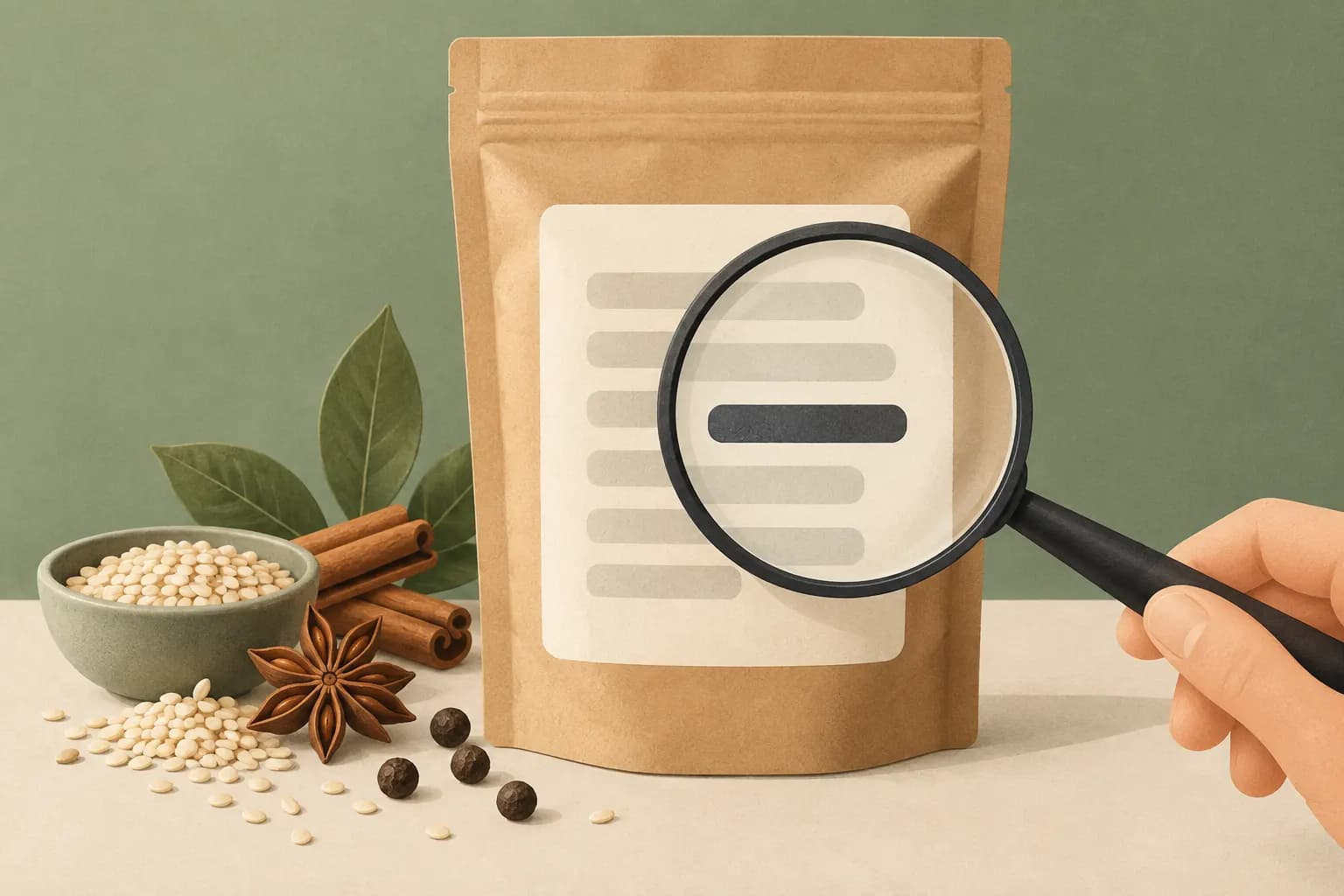
Mandatory information must be visible, legible and indelible. It must not be hidden or interrupted by other material, under Article 13(1).
Who is responsible for the label?
The food business operator under whose name the food is marketed is responsible for the food information under Article 8(1). If the product carries your brand, your business remains responsible even when a co-packer drafts and applies the label.
The brand must provide accurate recipes, supplier specifications and product data. The final artwork should be approved before printing.
Which language must an EU label use?
Mandatory food information must appear in a language easily understood by consumers in the Member State where the food is marketed. Article 15 allows Member States to require one or more official EU languages. Plan the language set for every destination country before approving the artwork.
How should allergens be shown?
Annex II allergens must be named and distinguished from the rest of the ingredient list by typeface, style or background colour. Bold type is one option if the result remains legible. A “may contain” statement does not replace allergen controls or the declaration of an intentionally used ingredient. Assess precautionary wording against the actual process and supplier records.
What is the minimum font size?
The x-height must normally be at least 1.2 mm. It may be 0.9 mm where the largest surface is below 80 cm². Articles 13(2) and 13(3), with Annex IV, refer to the measured x-height rather than a point size.
When is a nutrition declaration required?
A nutrition declaration is generally mandatory, but Annex V contains exemptions. These may cover certain single-ingredient unprocessed foods, herbs and spices, coffee, and specified teas or infusions. Added sugar, fruit or another ingredient can change the assessment. Confirm the exemption against the final recipe and sales route.
How are dates and batch codes shown?
Annex X governs date wording and format. The responsible operator determines durability from the food, packaging and storage conditions. Agree it for the actual product before print.
Directive 2011/91/EU governs lot identification. Use “L” where the lot code is not clearly distinguishable from other information. A minimum durability date can serve as a lot indication only under the conditions in Article 5(1)(a). The code must connect to traceability records.
When is origin information required?
Origin is required where omitting it could mislead consumers, particularly where the packaging suggests a different origin. Article 26(3) may apply when the stated origin of the food differs from that of its primary ingredient. Review flags, maps and place names as part of the claim.
What changes for coffee, tea and spices?
| Product | Question before print |
|---|---|
| Single-ingredient coffee | Does the name identify the ingredient, and does an Annex V nutrition exemption apply? |
| Flavoured coffee or a blend | Are every ingredient, allergen and required quantity covered? |
| Tea without additions | Does it meet the relevant Annex V conditions? |
| Tea with fruit, sugar or other additions | Is there an ingredient list, and has nutrition been reassessed? |
| One spice | Does the food name make the ingredient’s nature clear? |
| Spice blend | Are ingredients ordered correctly and allergens emphasised? |
Article 19(1)(e) provides an ingredient-list exemption for some single-ingredient foods. The word “blend” does not create an exemption.
Which claims should be avoided?
Food information must not mislead consumers about composition, quantity, durability, origin or method of production. Ordinary food must not be presented as treating or preventing disease. Article 7(4) applies these rules to advertising and presentation as well as labels.
The terms “organic” and their EU-language equivalents must comply with Regulation (EU) 2018/848. General environmental claims need adequate support under Directive (EU) 2024/825.
Where do brands most often slip up?
These mistakes keep appearing in Polish food-safety warnings and inspections:
- The allergen is listed but not emphasised. Listing it is not enough. In July 2026 the Polish Chief Sanitary Inspectorate (GIS) issued a public warning about a product whose label did not emphasise sulphites (GIS notice of 20 July 2026).
- A spice sachet under 5 g without a net quantity. The exemption for packs under 5 g does not cover spices and herbs (Annex IX, point 1(c)). This also applies to samples and campaign sachets.
- A batch identified only by the date. The rules allow it, but a recall then covers everything with that date. A separate lot code narrows it to one delivery (Directive 2011/91/EU, Article 5).
- A herbal infusion sold as “tea”. In a 2024 inspection by the Polish agricultural quality inspectorate (IJHARS), 167 of 325 batches of coffee and tea were labelled incorrectly. Findings included herbal infusions named tea and “100% robusta” containing arabica (report on the inspection results, in Polish).
- “Superfood” or “detox” on the front. These are general health claims. They may only appear next to a specific claim from the EU register (Article 10(3) of Regulation (EC) No 1924/2006).
- A four-language label on a small pouch. Each market needs a language its consumers understand (Article 15). With several language versions, the 1.2 mm minimum is what most often breaks.
How can Scoop & Pack help?
Scoop & Pack weighs and packs dry food under client brands and applies labels. It can prepare label content covering ingredients, allergens and nutrition, or print a compliant client file. Work is carried out under HACCP. Support is scoped during the individual quote.
Production artwork should be PDF in CMYK, with images at least 200 ppi and preferably 300 ppi, 2 mm bleed, a 2 mm safe zone, CutContour on a separate layer and White_Ink where required. Do not include printer’s marks.
Sources
- Regulation (EU) No 1169/2011: Articles 7–9, 13, 15, 17–28 and 30; Annexes II, IV, V and X.
- Directive 2011/91/EU: Articles 3 and 5.
- Directive (EU) 2024/825.
- Regulation (EU) 2018/848.
- Regulation (EC) No 1924/2006, Article 10(3).
- GIS public warning of 20 July 2026: sulphites not emphasised (in Polish).
- IJHARS coffee and tea inspection results, Polsat News report of 27 August 2024 (in Polish).
Configurator preview vs print file
The preview in the configurator accepts ordinary graphics (PNG, JPG, WebP) — it's just a visualisation so you can see the label on the packaging. The production file for print has stricter requirements (below) — we prepare it together.
Recommended label sizes
| Packaging | Label area | Min. resolution |
|---|---|---|
| Doypack (stand-up pouch) | ~101×124 mm (rectangular) | ≥1193×1465 px |
| Sachet | ~90×80 mm (rectangular) | ≥1063×945 px |
| Cardboard tube | ~45×60 mm (rectangular) | ≥531×709 px |
Sizes are approximate and depend on the final packaging and fill weight.
Production file requirements (for print)
- File format: PDF 1.6 (flattened; no AI/CDR/PSD files).
- Colour space: CMYK (no embedded profiles; PANTONE/HKS converted to CMYK).
- Bitmap resolution: min. 300 ppi (recommended 360 ppi).
- 1 mm bleed per side; safe zone ≥1 mm from the cut edge.
- Die-cut outline (CutContour) on a separate layer; white underprint (White_Ink) for transparent and metallic labels.
- No printer's marks.
Materials and shapes
Semi-gloss white paper, kraft paper (natural), white and transparent film, silver/gold metallic; standard, strong and removable adhesives. Shapes: rectangular, square, oval, round, or any custom die-cut.
Legal basis for the label
Food product labels must meet the requirements of EU Regulation (EU) No 1169/2011 on the provision of food information to consumers (including name, ingredients, allergens and nutrition declaration). Prepare a compliant label with us in the product creator.